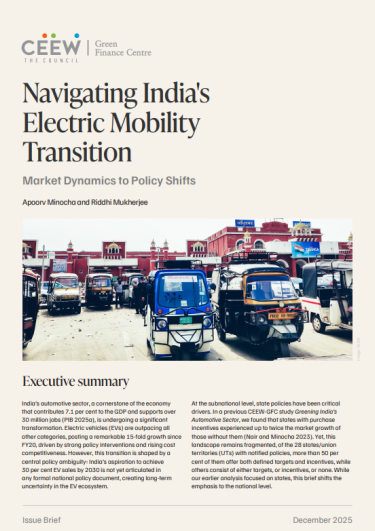
India's automotive sector, a cornerstone of the economy that contributes 7.1 per cent to the GDP and supports over 30 million jobs (PIB 2025a), is undergoing a significant transformation. Electric vehicles (EVs) are outpacing all other categories, posting a remarkable 15-fold growth since FY20, driven by strong policy interventions and rising cost competitiveness. However, this transition is shaped by a central policy ambiguity: India’s aspiration to achieve 30 per cent EV sales by 2030 is not yet articulated in any formal national policy document, creating long-term uncertainty in the EV ecosystem.
At the subnational level, state policies have been critical drivers. In a previous CEEW-GFC study Greening India’s Automotive Sector, we found that states with purchase incentives experienced up to twice the market growth of those without them (Nair and Minocha 2023). Yet, this landscape remains fragmented, of the 28 states/union territories (UTs) with notified policies, more than 50% of them offer both defined targets and incentives, while others consist of either targets, or incentives, or none. While our earlier analysis focused on states, this brief shifts the emphasis to the national level. It presents a data-backed analysis of EV adoption trends, and evaluates the design, performance, and evolution of India’s key national frameworks, specifically comparing the FAME II scheme and the new PM EDRIVE.
At the national level, India’s EV market has expanded dramatically from just 2,348 units in FY15 to approximately 1.96 million units in FY25, pushing overall penetration to 7.49 per cent. The post-COVID period, particularly FY22, served as a major inflexion point, driven by policy incentives and increased vehicle availability. This growth has also involved a significant structural transformation. While early adoption (FY20-FY21) was overwhelmingly dominated by E-rickshaws, E2W sales began to surge from FY22. By FY25, E2Ws had become the largest segment, with over 1.15 million units sold, signalling a market maturing from informal transport to private consumer adoption and logistics.
State-level EV adoption, however, varies widely and correlates strongly with economic capacity (GSDP per capita), revealing two distinct pathways. Higher-income states and UTs (e.g., Goa, Delhi, Karnataka) exhibit broader, diversified adoption across E2Ws, E4Ws, and E-buses; E2W penetration in this group is nearly five times higher than in lower-income states. Conversely, lower-income states (e.g., Tripura, Bihar, Uttar Pradesh) exhibit electrification almost entirely anchored by E3Ws, which account for over 52 per cent of their EV penetration. This divergence highlights a significant challenge in ensuring the transition is equitable and broad-based across all regions.
Compared to FAME II, which focused on broad market activation, PM EDRIVE adopts a system-level approach: it expands coverage across vehicle categories (E2W, E3W, E-buses, E-trucks, and E-ambulances), halves per-unit demand incentives, doubles the outlay for charging infrastructure (INR 20 billion), strengthens localisation through an Aadhaar-enabled E-voucher system, and introduces scrappage provisions for E-trucks and E-buses.
This indicates that policy efficiency has remained robust even with a threefold expansion in ambition.
This demonstrates improved cost-effectiveness, with the programme achieving more vehicles per unit of subsidy.

This divergence suggests that PM EDRIVE's uniform incentive structure may not sufficiently address the economics of highly price-sensitive segments.
India's EV transition is accelerating and maturing. The market is diversifying, and national policy has successfully evolved from fostering initial demand to building a deeper, more resilient ecosystem, as evidenced by PM EDRIVE's "‘more-with-less‘ performance. However, persistent challenges remain. Adoption is uneven across states, with growth concentrated in commercial-use segments. To ensure India's EV transition is not only fast but also inclusive and sustainable, this brief puts forward four key priority actions as recommendations:
1. Formalise the national EV target and improve policy coherence: India’s 30 per cent EV adoption goal for 2030, currently articulated by NITI Aayog, should be integrated into a national policy framework with category-wise sub-targets. As the power and industry sectors already operate under formal mission-led targets, a similar mandate for road transport—supported by a joint or individual roadmap from MHI and MoRTH—would strengthen long-term signalling for OEMs, financiers, and investors.
2. Promote stronger and more consistent state-level EV targets: EV policies vary widely across states. While more than 50 per cent of the states/UTs with notified policies specify measurable adoption targets and provide purchase incentives, some states remain operating with lapsed policies, or unclear targets/no incentives. Encouraging all states to adopt clear, updated, and aligned EV targets would help reduce regional disparities, especially between higher-income states with diversified EV adoption and lower-income states dominated by E3Ws.
3. Improve transparency of EV and charging-infrastructure data: While the PM EDRIVE portal reports scheme disbursement for E2W and E3W categories, key gaps remain for other supported categories and for charging infrastructure, which receives a significant share of the overall budget. Expanding the dashboard and establishing a unified national dataset would enable better monitoring, support mid-course policy adjustments, and offer clearer market signals.
4. Recalibrate PM EDRIVE budgets based on real-world uptake: Early FY25 trends show strong uptake in high-speed L5 E3Ws and weak performance in lower-speed e-rickshaws and e-carts. This divergence highlights the need for more dynamic budgeting. Periodic adjustments—channelling resources toward high-demand segments while revisiting incentive structures for slower-moving categories—would improve cost-effectiveness and ensure incentives reflect evolving market conditions and state-level variation.
India’s EV transition is no longer about if but how fast and how fairly. Ensuring that electrification reaches MSMEs, public fleets, rural markets, and informal transport operators will be central to building a truly inclusive and sustainable mobility system.