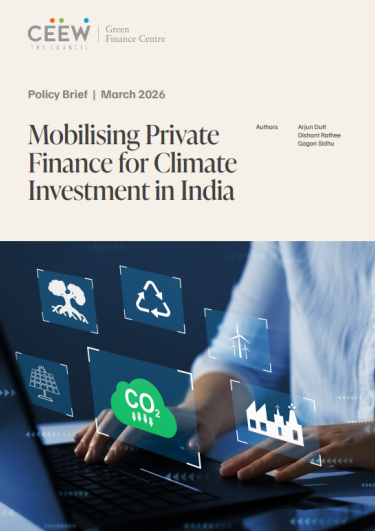
Combating climate change is one of the defining challenges of the 21st century. Accelerating decarbonisation and investing in climate adaptation are essential to limit the rise in the global average temperature and foster climate resilience, in line with the objectives of the Paris Agreement. Climate action, in general, entails considerable investment in hard physical assets. In the case of climate mitigation, these assets include solar panels, wind turbines, electric vehicles (EVs), charging infrastructure, and electrolysers. Climate adaptation similarly requires substantial investment in physical infrastructure, such as heat-resistant roofs, coastal embankments, storm shelters, and sanitation systems, complemented by non-infrastructure approaches, including community engagement and knowledge sharing. 

These physical assets are typically capital-intensive and well-suited to debt financing. For example, debt accounts for ~75 per cent of the capital expenditure of solar and wind power plants. As a result, adequate and affordable finance is a critical enabler of climate action, particularly in emerging market and developing economies (EMDEs). Yet, despite accounting for ~25 per cent of the global gross domestic product (GDP), these countries (excluding China) account for less than 15 per cent of global climate finance flows. This policy brief presents a unique 3x3 framework to mobilise private capital to address this pressing challenge in the Indian context, which may also find relevance in other EMDEs. 

The role of private finance in climate action 

The Fourth Report of the Independent High-Level Expert Group (IHLEG) on Climate Finance estimates that EMDEs (excluding China) will need to invest USD 3.2 trillion annually by 2035 in climate and nature to meet the goals of the Paris Agreement. It estimates that ~60 per cent of this requirement (USD 1.9 trillion) will need to be mobilised from domestic sources, with the remaining ~40 per cent (USD 1.3 trillion) coming from external sources.

Although the finance mobilised from both domestic and external sources will comprise a mix of public and private capital, the IHLEG highlights significant gaps pertaining to private capital. It estimates that private finance flows from domestic and external sources would need to increase by 9-fold and 16-fold, respectively, to meet annual investment needs by 2035. This is unsurprising considering the constraints on availability of public capital in EMDEs, whether from domestic or international sources. In EMDEs, the fiscal space for climate action is constrained by the need to service elevated sovereign debt and fund competing development priorities. Further, aid from developed countries is projected to decline by 9–17 per cent in 2025, following the 9 per cent decline in 2024. 

In this global context, India’s climate ambitions also require large-scale investments. Three sectors— power, road transport, and industry—collectively account for ~70 per cent of India’s greenhouse gas (GHG) emissions. Achieving net-zero emissions by 2070 would require investments of ~USD 10 trillion to decarbonise these sectors over the 50-year period leading up to that year. More recently, the NITI Aayog, in a report released in February 2026, which followed a different set of assumptions, estimates that India will require ~USD 22.7 trillion for decarbonising these sectors. In the near term, decarbonising these sectors represents a ~USD 500 billion investment and sales opportunity by 2030. In addition, India will need to invest ~USD 700 billion by 2030 in climate adaptation to build resilience.

How have existing policies facilitated private finance mobilisation? 

Mobilising private finance at scale is essential to meet India’s investment requirements. In this context, policy and regulation play a critical role in creating enabling conditions for the flow of private capital. India’s policy landscape, comprising sectoral and cross-cutting policies across mitigation and adaptation, features a multi-dimensional approach to creating the necessary enabling investment environment. With respect to mitigation, policies on renewable energy (RE), electric mobility, and green hydrogen (GH2) span several dimensions, including sectoral targets, procurement transparency, demand certainty, supporting infrastructure, offtaker risk, financial incentives, fiscal incentives, and a carbon market. 

With respect to adaptation, the central government has identified seven key sectors – agriculture and allied sectors, water, forestry and biodiversity, coasts and islands, the Himalayan ecosystem, disaster management, and health. Policy interventions to build climate resilience similarly operate across various dimensions. These include the National Action Plan on Climate Change (NAPCC), the National Adaptation Fund for Climate Change, state action plans on climate change (SAPCC), heat action plans, financial incentives for municipal bond issuance, and schemes that deliver adaptation-related co-benefits. 

Beyond sectoral measures, a range of cross-cutting policies and regulations, particularly by finance-sector policymakers and regulators, have further facilitated climate finance flows. These include the Framework for Sovereign Green Bonds, engagement with Article 6 international carbon markets, foreign direct investment (FDI) regulations, RBI’s priority sector lending regulations, the Framework for Green Deposits, Business Responsibility and Sustainability Reporting (BRSR), Securities and Exchange Board of India (SEBI) frameworks for green and environmental, social, and governance (ESG) bonds, and the International Financial Services Centres Authority’s (IFSCA) Framework for Transition Bonds. 

In addition, some cross-cutting measures were in the draft stage at the time of writing. These include India’s climate finance taxonomy and a framework for lenders to disclose climate-related financial risks (applicable to specific Reserve Bank of India (RBI)- regulated entities).

Climate finance in India: Current flows and desired levels 

The evolving policy environment has helped catalyse significant climate finance flows in India. The average annual climate mitigation finance flows for 2021–22 stood at USD 50 billion. The majority of these flows (83 per cent) were sourced domestically. Within domestic sources, the private sector contributed nearly two-thirds (66 per cent), while public sources made up the remainder through budgetary expenditure by the central and state government and investments by public sector undertakings (PSUs). International sources accounted for the remaining ~17 per cent of climate mitigation flows, of which 63 per cent came from private investors and the remainder from public sources. 

In contrast, the average annual climate adaptation finance flows for 2021–22 in India amounted to ~USD 15 billion. Nearly all these flows (98 per cent) were sourced from domestic public sources, primarily from central and state government budgets. International public finance accounted for the remaining 2 per cent, most of which was channelled through multilateral development finance institutions. Private-sector capital flows in adaptation finance were thus negligible. 

Existing capital flows need to be scaled up substantially for India to meet its climate ambitions. Achieving net-zero emissions by 2070 requires an average annual investment of USD 450 billion in climate mitigation over the 45-year period leading up to 2070, implying 9x of current levels. In the case of adaptation, India requires investments of ~USD 100 billion per year through 2030, necessitating an increase in flows to six- to seven-times of current levels. In this context, private capital will play a critical role in achieving climate action. To illustrate, the International Monetary Fund (IMF) projects limited growth in public climate investment across EMDEs (excluding China) and estimates that private capital would need to account for ~90 per cent of annual climate mitigation investment needs by 2030 in these countries. From India’s perspective, scaling climate capital flows to levels commensurate with its ambitions therefore requires both expanding overall climate-aligned capital flows and increasing the share of private-sector flows.

Understanding financing bottlenecks 

Elevating capital flows to the required levels will necessitate interventions that systematically address financing bottlenecks. To further this objective, the Council on Energy, Environment and Water (CEEW) conducted interactions with key stakeholders, primarily from the private sector. Stakeholders were selected to ensure balanced representation across three categories: lenders, funds and other stakeholders. Discussions were tailored to each stakeholder depending on the category and focused on eliciting views on both financing barriers and potential enabling conditions. 

Findings of these stakeholder discussions, supplemented by CEEW’s analysis, were synthesised into a structured framework for mobilising private-sector finance. To enhance its usability as a policy reference tool, this framework is presented as a simplified 3×3 matrix. Along one dimension, all financing challenges are grouped into three categories: (a) flow, (b) cost, and (c) scale. Along the other, all solutions are organised into three categories: (a) instruments, (b) institutions, and (c) policies and regulations. Each instrument or policy/regulation has been paired with an institution that is best-suited to anchor it. This framework is designed to facilitate targeted, challenge- and sector-specific solutions across power, industry, road transport, and adaptation, rather than broad, overarching solutions.

Table 1. Framework for the mobilisation of private finance for climate investments


11 People Liked
For queries reach out to author
Posted On
17 March 2026
Tags
Climate Finance
Financial Instruments
Climate policy
Private investments
Share
PUBLICATIONS
Others
March 2026
4 mins read
Arjun Dutt
GFC ANALYSIS
Instruments & Regulations
+ 1 More
July 2019
5 mins read
Kanika Chawla
GFC ANALYSIS
Renewable Energy
August 2020
3 mins read
Gagan Sidhu
PUBLICATIONS
Electric Mobility
December 2025
4 mins read
Apoorv Minocha
PUBLICATIONS
Industrial Decarbonisation
+ 1 More
October 2025
7 mins read
Charmi Mehta
PUBLICATIONS
Instruments & Regulations
+ 1 More
September 2025
10 mins read
Arjun Dutt
GFC ANALYSIS
Instruments & Regulations
+ 1 More
March 2020
4 mins read
Nikhil Sharma
GFC ANALYSIS
Others
+ 1 More
October 2021
2 mins read
Saloni Jain
GFC ANALYSIS
Renewable Energy
July 2019
3 mins read
Gagan Sidhu