Context
According to the World Economic Forum’s Global Risks Report 2025, environmental risks form the biggest challenge in both the short and long term. The risk attributed to climate-related factors intensifies over the time period, and they account for four of the top five risks in the long term (Elsner, Atkinson, and Zahidi 2025). Among other things, this has implications for the financial architecture at large, both internationally and at the domestic level.
As countries around the world attempt to avert some of the worst impacts of climate change, businesses have emerged as important agents of change—taking the lead in sustainability efforts, undertaking system-wide transformations to green their manufacturing, distribution, and investment-making processes. Corporate emissions disclosure frameworks have been among the upshots of this initiative, as a means to make the process more transparent and boost accountability. Corporate sustainability disclosures have been a growing field of focus for many years now. While emerging economies are catching up to the challenge, advanced economies have been implementing these for much longer, and offer key lessons to newer players like India.
This report seeks to compare Indian corporate emissions disclosure frameworks--those that exist and those in the works--with similar initiatives from six global jurisdictions (including the EU, the UK and South Korea), to offer actionable pointers for India to cement its disclosure mechanisms beyond any scope of manipulation and to better monitor its larger aims vis-a-vis climate change.
Key Findings - Emissions disclosures landscape in India
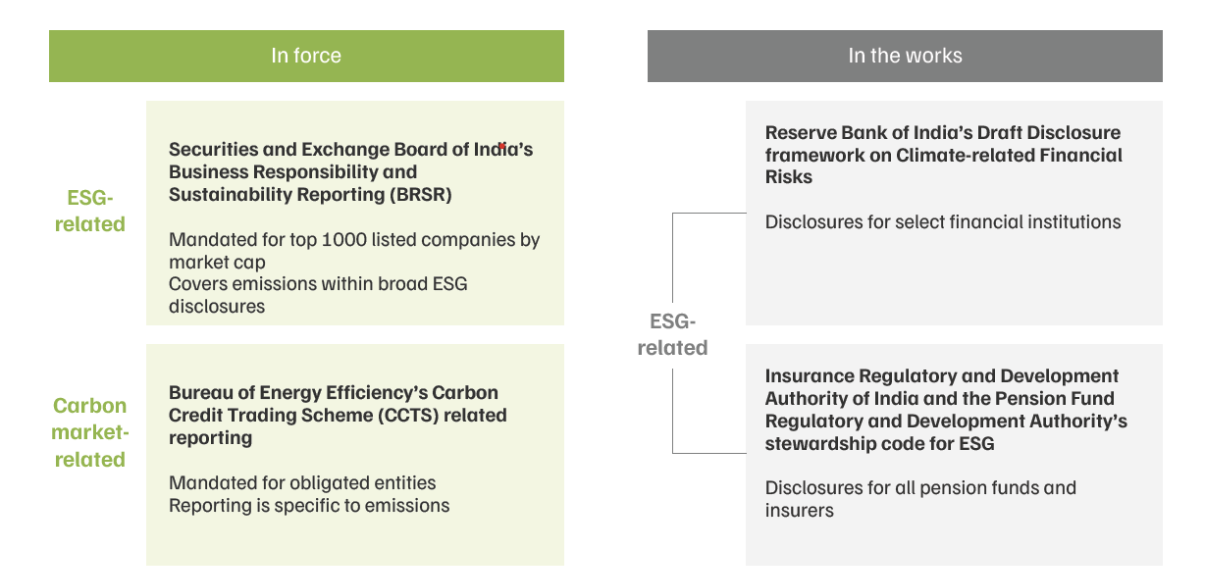
Emissions disclosures in India are mandated either as a part of broad Environment, Social and Governance (ESG) disclosures, or through emissions reporting requirements under the compliance carbon market (required FY26 onwards). Currently, Securities and Exchange Board of India (SEBI)’s Business Responsibility and Sustainability Reporting (BRSR) is the only disclosure mandate in India–covering emissions within the broad ESG disclosure framework. It is mandatory to file for the top 1000 listed companies by market capitalisation.
The other form of emissions reporting–mandated by the compliance carbon market will also be enforced shortly (FY26 onwards) for obligated entities, with the commencement of the Carbon Credit Trading Scheme (CCTS), administered by the Bureau of Energy Efficiency (BEE). Several of these regulated unit-level entities included under the CCTS belong to companies that are also required to make BRSR filings under the SEBI mandate, and make ESG disclosures.
Other regulators, such as the Reserve Bank of India (RBI), the Insurance Regulatory and Development Authority of India (IRDAI), and the Pension Fund Regulatory and Development Authority (PFRDA) have also integrated ESG risk monitoring within their regulatory purview, but are yet to introduce disclosure templates.
Figure ES1. Locating emissions disclosures within the Indian sustainability disclosures landscape
Source: Authors’ analysis
Corporations are a significant source of emissions across sectors, which makes them a useful cross-cutting lever to drive emission reductions. India’s total emissions stand at about 3 billion tonnes of carbon dioxide equivalent (tCO2e). Of this, the top 1,000 listed companies account for about 43 per cent (1.3 billion tCO2e).
Considering the sizable emissions by large corporates in India and the existing coverage of emissions disclosures across different reporting mandates, the report sets out three important questions to address and guide the development of emissions disclosure frameworks in India:
1. Can the landscape of emissions disclosures be expanded to cover a greater share of emissions without creating unintended spillovers for non-emitters?
2. Can the quality and integrity of emissions disclosures be improved to enhance its utility for corporates, regulators, and investors?
3. What are the opportunities for convergence and building interoperability between the dual reporting mandates?
Learning from global disclosure and emissions reporting frameworks
Defining the coverage of reporting mandates is a critical component of the disclosure design, as it determines who must report and why. In terms of the applicability of environmental, social, and governance (ESG) disclosure frameworks, global jurisdictions primarily follow the approach of determining coverage based on company revenues (as well as number of employees in the case of EU and UK). In India, meanwhile, the coverage of the BRSR framework is determined on the basis of market capitalisation, while the upcoming RBI climate-risk disclosures will be mandated for select financial institutions, once introduced.
Identifying relevant report attributes is essential to ensure higher quality reporting. In terms of the key disclosure requirements, a review of global best practices highlights two key aspects: (i) reporting of all three scopes of emissions (scope 1, 2, and 3), and (ii) mandatory assurances for reported data. In India, scope 3 emissions (value chain) disclosures are so far limited to BRSR Core, requiring ‘assessment’ vis-a-vis ‘assurance’. The RBI framework includes scope 3 emissions reporting, it is yet to specify assurance requirements. MRV protocols under India’s CCTS require third-party assurance, in line with global best practices. Hiving off non-material indicators is likely to positively incentivise reporters, and potentially minimise the need for regulatory mandates from various directions.
The utilisation of digital technologies to monitor and report emissions is a key aspect supplementing the evolution of the corporate disclosures landscape, enabling harmonisation between various reporting compliances. The US state of California, for example, uses its digital architecture to harmonise emissions monitoring and recording for reporting under different disclosure frameworks (ESG-related and carbon markets-related). Its Greenhouse Gas Reporting Tool (Cal e-GGRT) creates accessible profiles for each reporting facility, allowing corporates to directly compile and report emissions. In India, CCTS guidelines do not specify the requirements of digital emissions monitoring.
Encouraging an ecosystem-level transformation of corporate behaviour towards emissions and associated climate disclosures, including medium-sized enterprises, can have long-term benefits for mainstreaming disclosures and ushering in a culture of transparency. In this light, the EU has expanded its emphasis beyond large corporates, to build capacity within medium-sized enterprises on emissions measurement and reporting, through industry-aligned training.
Key recommendations – Charting a pathway for emissions disclosures in India
The study consolidates learnings from other jurisdictions such as the European Union, California, South Korea, and the United Kingdom, to develop a set of levers that can ensure new mechanisms put into place for improving emissions disclosures have multi-faceted utility for corporations, and helps them spotlight their growing sustainability profiles without adding to their regulatory obligations. Of the 1,000 companies mandated to file BRSR, 998 did so in 2024. However, filing the report does not guarantee completeness or accuracy of data. For instance, only 781 companies reported scope 1 and 2 emissions, which are essential indicators for reporting (Authors’ analysis based on a study of BRSR reports for FY24-24). The study identifies four fundamental levers, which focus not just on increasing reporting, but also enhancing its quality. Along these levers, several pertinent action points emerge:
1. Enhance coverage of emissions based on empirical evidence - Any expansion of reporting coverage must be guided by an evidence-based assessment of corporate contribution to national emissions. For instance, the top 1,000 companies contribute ~1.3 billion tCO2e (43% of India’s total emissions), whereas the emissions from companies between top 500 and top 1,000 are ~0.3 billion tCO2e (which amounts to a ~30 per cent of an increase for doubling the number of companies reporting). This suggests that going beyond the top 1,000 alone may not yield substantial gains on emissions coverage, and may actually inappropriately widen the corporate net without widening the emissions net. However, there is scope to extend emissions reporting coverage beyond 43 per cent (share of the top 1,000), and two options emerge in this regard:
- Expanding the coverage of non-BRSR frameworks, such as those of the RBI, the IRDAI, and the PFRDA that are expected to enter into force; or
- A revenue-based threshold, as in other jurisdictions, that will widen the net to include large non-listed firms, preventing smaller listed entities from getting covered.
2. Strengthen quality and integrity of disclosures - To do this, SEBI may consider a single report, possibly an expanded version of BRSR Core with assurances. It can then do away with the BRSR Comprehensive entirely. Assurances must also be mandatory under the RBI, IRDAI and PFRDA frameworks, when introduced. This will help improve the quality of disclosures. Further, SEBI recently mandated ESG mutual funds to invest 65 per cent of their assets under management (AUM) in BRSR-compliant companies. Regulations should avoid reinforcing BRSR compliance without focusing on action, as the often incomplete and inaccurate nature of corporate reporting can potentially misdirect ESG funds to invest without due diligence on their part, ultimately impacting the integrity of the disclosure process.
3. Real-time emissions monitoring system interoperable with other reporting compliance - Currently, emissions estimation is undertaken internally by corporates and manually updated into the BRSR filing. For ease of reporting and verification processes, use of a real-time emissions monitoring system interoperable with other reporting compliances can be encouraged. This platform may be designed for utilisation by corporates, to track emissions for general corporate disclosures. With India on the cusp of operationalising its own domestic carbon market, putting such a system in place can potentially have widespread benefits for the entire emissions monitoring ecosystem, and create a bottom-up source for emissions data in the country.
4. Build ecosystem capacity for emissions measurement and reporting - In several industries, MSMEs collectively contribute a significant share of carbon emissions, despite their individual footprints being small. Accurate reporting will help MSMEs identify inefficiencies, reduce costs, and enhance sustainability, making them more competitive in global markets. While SEBI introduced the BRSR Lite format for voluntary reporting, it does not include emissions. Ideally, if the objective is to build reporting capacity among smaller companies, emissions disclosure should be included as they are a requirement for MSMEs that are part of large corporation supply chains (BRSR Core requires value chain disclosures). This will close the loop on value chain disclosures. Capacity building programmes can be guided by those provided by the European Financial Reporting Advisory Group (EFRAG) and Malaysia, as they have taken active steps, in terms of reporting frameworks and tailored training programs, to bring their SME sectors under the larger supply chain sustainability considerations.
These levers lend themselves to a complete re-imagination of disclosure formats, from compliance-driven reporting to a corporate sustainability report card that reflects companies’ efforts towards embedding climate action in their systems and processes.
A proposal for a blueprint to enhance corporate emissions disclosures in India
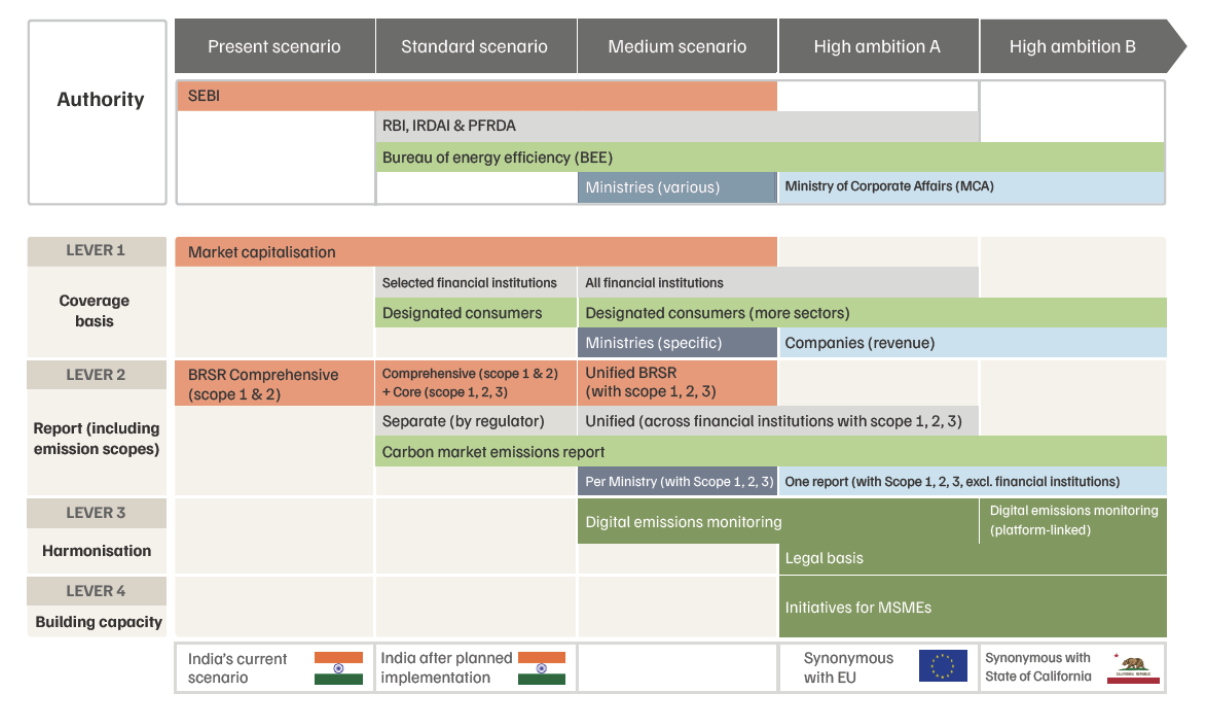
The levers discussed above are stacked into ambition-based scenarios, each presenting policy and regulatory trade-offs they are likely to face (Figure ES2). Further, the scenarios also demonstrate where other jurisdictions stand. This analysis is useful for informing the level of ambition that is best-suited for India’s broader emissions reductions goals—in terms of both, the ease and efficacy of implementation and the strengthening of regulatory oversight for enhanced corporate climate action, and the choice of a suitable pathway going forward.
Figure ES2. Potential corporate emissions disclosure scenarios for India
Source: Authors’ analysis
A robust, internationally comparable and credible disclosure framework is a critical step towards mainstreaming corporate sustainability and enhancing access to green finance for Indian companies. While the decision on the ambition level for India must be rooted in the country’s larger climate action goals over the medium and long-term, the scenarios present a progressive pathway forward, conducive for both, ambitious reforms and incremental policy-making.