What are ESG debt securities?
Environmental, Social, and Governance (ESG) debt securities are tradable fixed-income instruments through which issuers raise capital earmarked for environmental, social, or governance-linked purposes.1 Unlike conventional debt securities, ESG debt securities carry a label and a set of obligations linked either to the use of proceeds or to the issuer’s corporate performance against predetermined sustainability targets.2 Also referred to as GSS+ (green, social, sustainability, and sustainability-linked+) bonds, ESG debt securities help corporations and institutions raise sustainable finance and align capital allocation with broader sustainability commitments.
Types of ESG debt securities
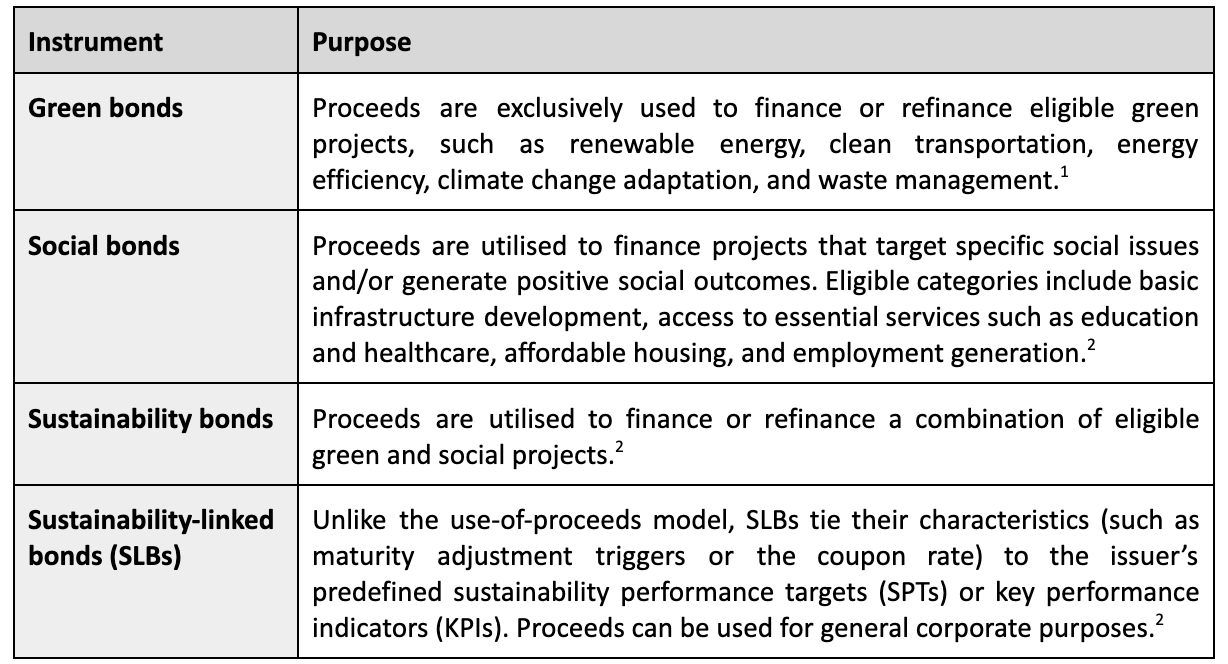
ESG debt securities are broadly classified into four categories – green bonds, social bonds, sustainability bonds, and sustainability-linked bonds – based on the specific use of proceeds or linkage to the issuer’s sustainability-related performance.
Table 1. Types of ESG debt securities
Regulatory framework for ESG debt securities in India
ESG debt securities in India are issued under two distinct regulatory jurisdictions:
A. Domestic market
Bonds listed on Indian stock exchanges, such as the Bombay Stock Exchange (BSE) and the National Stock Exchange of India (NSE), are regulated by the Securities and Exchange Board of India (SEBI). In December 2024, SEBI formally recognised ESG debt securities as a distinct asset class through an amendment to the SEBI (Issue and Listing of Non-Convertible Securities) Regulations, 2021 (also known as the SEBI [NCS] Regulations, 2021).3 This amendment introduced four sub-categories of ESG debt securities: green debt securities, social bonds, sustainability bonds, and sustainability-linked bonds.
Prior to this amendment, only green debt securities had an explicit regulatory framework under SEBI. These were primarily governed through SEBI’s Disclosure Requirements for Issuance and Listing of Green Debt Securities, 2017 4 and subsequently through SEBI (NCS) Regulations, 2021,3 under which they were subsumed (under Chapter IX). Although Indian entities occasionally issued social bonds, sustainability bonds, and sustainability-linked bonds in alignment with international standards, such as the International Capital Market Association (ICMA) principles, these instruments did not have a dedicated, codified domestic regulatory framework until the 2024 amendment to the SEBI (NCS) Regulations.
Currently, GSS+ bonds listed on Indian stock exchanges are governed under the SEBI (NCS) Regulations, 2021 (as amended in 2024)1 and the SEBI Framework for Environment, Social and Governance (ESG) Debt Securities (other than green debt securities)2 (issued in 2025).
B. GIFT City (IFSC): Within the International Financial Services Centre (IFSC) at GIFT City, Gandhinagar, ESG debt securities issued on exchanges are governed by Chapter X of the IFSCA (Listing) Regulations, 2024.5
Figure 1. Evolution of India’s regulatory architecture for ESG debt securities
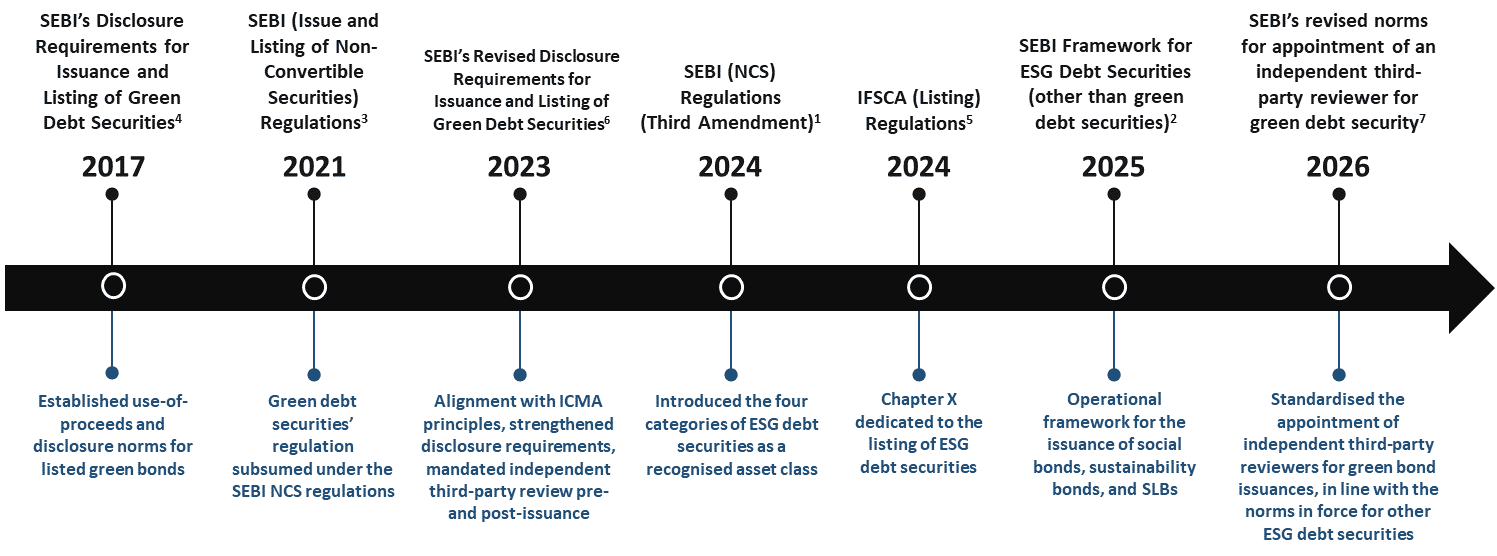
Source: Author’s analysis based on various sources1,2,3,4,5,6,7
Bond issuance requirements under the current regulations
To ensure the credibility of issued ESG debt securities and to safeguard the interest of investors, both SEBI and IFSCA have established several issuance principles for ESG debt securities as well as pre- and post-issuance disclosure requirements. Across issuance principles and disclosure requirements of both regulators, there are broad commonalities. These include:2,5,6,7
- Eligibility and labelling principles: Under both SEBI and IFSCA regulations, debt securities can carry an ESG label only upon alignment with recognised standards, such as the ICMA Principles, the Climate Bonds Standard, ASEAN Bond Standards, or frameworks notified by Indian financial regulators. Further, under SEBI, proceeds from the instrument must be exclusively utilised to finance or refinance eligible projects or sectors, as defined by SEBI.
- Mandatory appointment of an independent third-party reviewer/certifier to confirm alignment with standards and verify the ESG labelling.
- Pre-issuance disclosures such as the project eligibility criteria, ESG objectives, proposed use of proceeds and the tracking mechanism for it, and alignment with the chosen framework.
- Post-issuance reporting including annual reporting on fund allocation, independently verified impact assessment, and performance against sustainability targets (for SLBs).
- Anti-purpose-washing safeguards which prohibit issuers from using misleading ESG labels, obscuring unfavourable data, or making false claims of third-party verification. Under SEBI’s regulations, any misalignment with the stated purpose of a GSS+ bond must be disclosed to investors, who can demand early redemption of the bond through a majority decision. Under IFSCA’s regulations, violations may result in penalties, suspension, or delisting of the bond.
The formalisation of issuance frameworks and regulations by SEBI and IFSCA is positioned to serve as a policy tailwind for the growing sustainable debt market in India. For instance, GSS+ debt issuances increased by 186 per cent between 2021 and the end of 2024.8 With new regulatory frameworks and safeguards for investors in place, the GSS+ bond market attract more interest.
Figure 2. Issuance volumes of ESG debt securities in India 9,10,11

Who should care?
- Corporate treasuries
- Public-sector enterprises
- Banks and non-banking financial companies (NBFCs)
- ESG fund managers
- Asset managers
References
- [1] SEBI (Securities and Exchange Board of India). 2024. Securities and Exchange Board of India (Issue and Listing of Non-Convertible Securities) (Third Amendment) Regulations, 2024. Securities and Exchange Board of India. https://www.sebi.gov.in/legal/regulations/dec-2024/securities-and-exchange-board-of-india-issue-and-listing-of-non-convertible-securities-third-amendment-regulations-2024_89762.html.
- [2] SEBI (Securities and Exchange Board of India). 2025. Framework for Environment, Social and Governance (ESG) Debt Securities (Other than Green Debt Securities). Circular No SEBI/HO/DDHS/DDHS-POD-1/P/CIR/2025/84. Securities and Exchange Board of India. https://www.sebi.gov.in/legal/circulars/jun-2025/framework-for-environment-social-and-governance-esg-debt-securities-other-than-green-debt-securities-_94424.html.
- [3] SEBI (Securities and Exchange Board of India). 2021. Securities and Exchange Board of India (Issue and Listing of Non-Convertible Securities) Regulations, 2021. Securities and Exchange Board of India. https://www.sebi.gov.in/legal/regulations/aug-2021/securities-and-exchange-board-of-india-issue-and-listing-of-non-convertible-securities-regulations-2021_51764.html.
- [4] SEBI (Securities and Exchange Board of India). 2017. Disclosure Requirements for Issuance and Listing of Green Debt Securities. Circular No CIR/IMD/DF/51/2017. Securities and Exchange Board of India. https://www.sebi.gov.in/legal/circulars/may-2017/disclosure-requirements-for-issuance-and-listing-of-green-debt-securities_34988.html.
- [5] IFSCA (International Financial Services Centres Authority). 2024. International Financial Services Centres Authority (Listing) Regulations, 2024. International Financial Services Centres Authority. https://ifsca.gov.in/Document/Legal/ifsca-listing-regulations-202430082024045210.pdf.
- [6] SEBI (Securities and Exchange Board of India). 2023. Revised Disclosure Requirements for Issuance and Listing of Green Debt Securities. Circular No SEBI/HO/DDHS/DDHS-RACPOD1/P/CIR/2023/023. Securities and Exchange Board of India. https://www.sebi.gov.in/legal/circulars/feb-2023/revised-disclosure-requirements-for-issuance-and-listing-of-green-debt-securities_67837.html.
- [7] SEBI (Securities and Exchange Board of India). 2026. Revised Norms for Appointment of an Independent Third-Party Reviewer/Certifier for Green Debt Security. Circular No HO/17/11/24(1)2026-DDHS-POD1/I/5967/2026. Securities and Exchange Board of India. https://www.sebi.gov.in/legal/circulars/feb-2026/revised-norms-for-appointment-of-an-independent-third-party-reviewer-certifier-for-green-debt-security_100043.html.
- [8] Climate Bonds Initiative. 2025. India Sustainable Debt State of the Market 2024. Climate Bonds Initiative and MUFG. https://www.climatebonds.net/files/documents/publications/Climate-Bonds_India_Sustainable_Debt_SotM_2024_Jun-2025.pdf.
- [9] SEBI (Securities and Exchange Board of India). n.d. “ESG Debt Securities.” Securities and Exchange Board of India. https://www.sebi.gov.in/statistics/greenbonds.html.
- [10] Compilation of [9] and Sharma, Yogima Seth. 2025. “Vertis Infrastructure Trust Raises Rs 900 Crore via SLB.” Economic Times, July 23. https://economictimes.indiatimes.com/industry/banking/finance/vertis-infrastructure-trust-raises-rs-900-crore-via-slb/articleshow/122856255.cms
- [11] IFSCA (International Financial Services Centres Authority). n.d. “Sustainable Finance.” International Financial Services Centres Authority. https://ifsca.gov.in/Pages/Contents/Sustainable_Finance#:~:text=ESG%2DLabeled%20Debt%20Listing%20as,No.&text=F.Y.