Context
Global public debt reached a record USD 102 trillion in 2024, with developing countries (excluding China) accounting for USD 31 trillion, nearly one-third of the total.1 Heightened public spending caused by the COVID-19 pandemic and elevated global commodity prices amid supply chain disruptions, have contributed to this rise in debt levels in developing economies. 2 According to the International Monetary Fund (IMF), the median debt-to-gross domestic product (GDP) ratio for 40 least developed countries (LDCs) has risen from 34 per cent in 2014 to 55 per cent in 2024. Similarly, among 80 other developing countries, the median debt-to-GDP ratio has grown from 40 per cent to 56 per cent over the same period.3 In 2024 alone, developing countries (excluding China) paid a record USD 921 billion in interest payments,1 highlighting rising debt-servicing costs that can potentially crowd out public expenditure in key areas for sustainable development. Notably, over 3.4 billion people are estimated to live in developing countries that spent more on interest payments on sovereign debt in 2024 than on health or education.1
At the same time, developing countries remain disproportionately vulnerable to the impacts of climate change,4 necessitating greater investments in resilience-building initiatives. Concurrently, their climate mitigation commitments under their nationally determined contributions (NDCs) require sustained investments to meet emissions-reduction targets. Against this backdrop of rising debt distress and pressing need for climate investments in developing economies, innovative financial instruments – such as debt-for-climate swaps – have emerged as a potential solution to channel spending towards climate-related activities without worsening existing indebtedness and fiscal constraints.
Origin of debt-for-nature and debt-for-climate swaps
The concept of debt swaps first emerged in the 1980s as a response to the Latin American debt crisis. The idea was first articulated by Thomas Lovejoy, then Vice President of WWF-US, who proposed an arrangement where “debtor nations willing to protect natural resources could be made eligible for discounts or credits against their debts”.5 In 1987, the concept materialised in the form of the first debt-for-nature swap, when a US-based environmental non-profit organisation, Conservation International, acquired a portion of Bolivia’s debt (worth ~USD 650,000) at a discounted price in exchange for legal protection of the Beni Biosphere Reserve.6 Over time, the concept has expanded beyond nature conservation to encompass broader climate-related activities.
What are debt-for-climate swaps?
Debt swaps today take several forms, including debt-for-nature and debt-for-climate swaps. As financial mechanisms, these allow debtor countries to reduce their external debt burden in exchange for committing to specific climate- or nature-related projects. Under such agreements, a portion of a nation’s debt is forgiven or restructured in exchange of an agreed commitment to reallocate a portion of the resulting debt-servicing savings to initiatives that mitigate climate change, enhance climate resilience, or support environmental conservation.7
As of 2022, over 30 countries had participated in debt-for-nature or debt-for-climate swaps. Cumulatively, these arrangements have restructured USD 2.5 billion in debt and unlocked USD 1.2 billion in financing.8 Although historically small in scale, recent transactions highlight the potential to amplify the volume of such deals. For instance, Belize restructured USD 364 million of debt in 2021 through a debt swap that financed marine conservation.9 Similarly, Ecuador’s Galápagos debt-for-nature swap in 2023 converted USD 1.63 billion in international bonds into a USD 656 million loan, resulting in USD 1.1 billion in debt-servicing savings and USD 450 million released for environmental conservation.10
Structure of debt-for-climate swaps
The debt swap mechanism involves a creditor – typically a developed country, an international financial institution, or a private entity – agreeing to forgive or restructure a debtor nation’s outstanding debt owed to that creditor.11 In return, the debtor nation commits to investing an equivalent amount, or a negotiated portion, in pre-agreed climate- or nature-related projects.
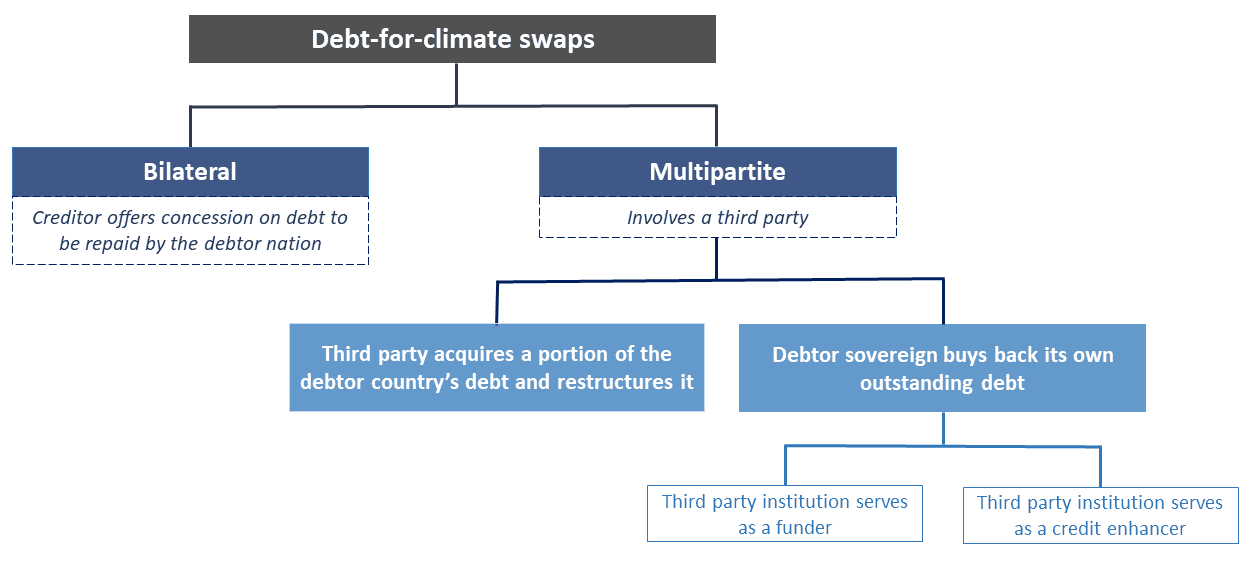
Debt swap arrangements can take either bilateral or multipartite structures:12
1. A bilateral debt swap structure involves only the creditor and the sovereign debtor, where the creditor provides a concession on the outstanding debt owed by the sovereign debtor and consequently absorbs a direct financial loss in exchange for the debtor’s commitment to invest in agreed climate- or nature-related projects.
2. A multipartite debt swap structure involves a third party, such as an NGO or a development finance institution, in addition to the creditor and the debtor. The role of the third-party institution varies depending on the nature of the arrangement:
- In some cases, the third party acts as an intermediary and buys out a portion of the debtor nation’s outstanding debt from the creditor at a discounted rate. It then restructures the debt for the debtor nation by replacing the previous arrangement with new, more favourable terms and conditions, such as lower interest rates, extended maturity periods, or local-currency denomination.12 This is undertaken in exchange for the debtor country’s commitment to channel a portion of the resulting savings towards an environmental or climate-related project.
- In other cases, the third party supports the debtor nation in buying back its own outstanding debt, either by serving as a donor institution or as a credit enhancer (to help attract commercial investors to finance the buyback). In return, the debtor nation commits to channel a portion of the resulting savings towards an environmental or climate-related project.
Figure 1: Structure of debt-for-climate/debt-for-nature swaps
Source: Author’s analysis based on GCF (2024)12
While debt-for-climate swaps as a financial instrument do not entirely resolve debt sustainability challenges for developing nations, they provide an avenue to unlock much-needed funding for climate- and nature-related investments by freeing up domestic resources that would otherwise be utilised for debt servicing. Consequently, they help direct capital towards green end uses while concurrently managing indebtedness.12,13
References
- [1] UNCTAD (United Nations Trade and Development). 2025. A World of Debt 2025. United Nations Trade and Development. https://unctad.org/publication/world-of-debt. Public debt here denotes a government’s domestic debt (including central, state, and local levels, alongside the social security funds controlled by them), as well as its external debt.
- [2] UNCTAD (United Nations Trade and Development). 2024. “Navigating the Growing Challenges of Public and External Debt.” United Nations Trade and Development. https://unctad.org/news/navigating-growing-challenges-public-and-external-debt.
- [3] UNCTAD (United Nations Trade and Development). 2024. “Mounting Fiscal Deficits and Debt in Least Developed Countries Require Urgent International Action.” United Nations Trade and Development. https://unctad.org/news/mounting-fiscal-deficits-and-debt-least-developed-countries-require-urgent-international.
- [4] US Global Leadership Coalition. 2021. “Climate Change and the Developing World: A Disproportionate Impact.” US Global Leadership Coalition. https://www.usglc.org/blog/climate-change-and-the-developing-world-a-disproportionate-impact.
- [5] Thomas E. Lovejoy. 1984. “Aid Debtor Nations’ Ecology.” New York Times. https://www.nytimes.com/1984/10/04/opinion/aid-debtor-nations-ecology.html.
- [6] James P. Resor. n.d. “Debt-for-Nature Swaps: A Decade of Experience and New Directions for the Future.” The Food and Agriculture Organization. Accessed February 7, 2026. https://www.fao.org/4/w3247e/w3247e06.htm.
- [7] UNESCAP (United Nations Economic and Social Commission for Asia and the Pacific). 2021. Debt-for-Climate Swaps as a Tool to Support the Implementation of the Paris Agreement. United Nations Economic and Social Commission for Asia and the Pacific. https://www.unescap.org/sites/default/d8files/knowledge-products/PB_Debt-for-Climate%20Swaps_final.pdf.
- [8] NAP Global Network. 2024. “Debt-for-Nature Swaps/Debt-for-Climate Resilience Swaps.” NAP Global Network. https://napglobalnetwork.org/innovative-financing/debt-for-nature-swaps/.
- [9] The Nature Conservancy. 2021. Case Study: Belize Debt Conversion for Marine Conservation. The Nature Conservancy. https://www.nature.org/content/dam/tnc/nature/en/documents/TNC-Belize-Debt-Conversion-Case-Study.pdf.
- [10] GGGI (Global Green Growth Institute). 2023. “Ecuador Debt-for-Nature Swap in the Galapagos Islands Launched.” Global Green Growth Institute. https://gggi.org/ecuador-debt-for-nature-swap-in-the-galapagos-islands-launched/.
- [11] Georgieva, Kristalina, Marcos Chamon, and Vimal Thakoor. 2022. “Swapping Debt for Climate or Nature Pledges Can Help Fund Resilience.” International Monetary Fund (blog), December 14. https://www.imf.org/en/blogs/articles/2022/12/14/swapping-debt-for-climate-or-nature-pledges-can-help-fund-resilience.
- [12] GCF (Green Climate Fund). 2024. “Debt for Climate Swaps: Exploring Avenues and Opportunities.” Green Climate Fund. https://www.greenclimate.fund/sites/default/files/document/241015-debt-climate-swaps-gcf-feasibility-study-updated.pdf.
- [13] UNDP (United Nations Development Programme). 2023. (Re)Orienting Sovereign Debt to Support Nature and the SDGs: Instruments and Their Application in Asia-Pacific Developing Economies. United Nations Development Programme. https://www.undp.org/publications/reorienting-sovereign-debt-support-nature-and-sdgs-instruments-and-their-application-asia-pacific-developing-economies.