Context
Climate change presents a significant financial risk to financial sector worldwide, including financial institutions. As climate change makes extreme weather events more frequent and severe, financial stability stands threatened. The Bank for International Settlements (BIS) has termed this type of risk a "Green Swan" event, indicating that climate-change-related risks are complex, unpredictable, and potentially catastrophic.1 Moreover, in a recent international survey, climate change topped the list of long-term risks for banks. 2
In this light, central banks, financial regulators and institutions are adopting measures to identify, assess and manage climate-related financial risks. Globally, central banks are emphasising the importance of understanding how physical risks (such as climate-induced natural disasters) and transition risks (arising from the shift to a low-carbon economy) could impact the economy and financial system.
In India, the Reserve Bank of India (RBI) has started acknowledging the risks climate change poses to financial stability, and is proactively addressing climate-related financial risk. So far, it has released four guidance documents on climate risk.
- Discussion Paper on Climate Risks and Sustainable Finance (July 2022) — Emphasises the importance of integrating climate risk into financial strategies and governance frameworks, and touches upon capacity-building in the Indian financial sector.3
- Report on the Survey on Climate Risk and Sustainable Finance (July 2022) — Contains the results of interviews with 34 banks, both domestic and international, spanning the public as well as private sectors. 4
- Report on Currency and Finance (May 2023) — An annual report, with a thematic focus on climate risks, especially in the context of their macroeconomic implications and those for the financial sector. It highlights a wide range of climate-related topics in the context of the Indian banking sector.5
- Draft disclosure framework on climate-related financial risks (Feb 2024) — The framework mandates disclosures by regulated entities (REs) in four key areas of governance, aligning it with the disclosure framework under the Task Force on Climate-related Financial Disclosures (TCFD)6.
The RBI has also announced plans to release guidance on scenario analysis and stress testing.
Scenario analysis: A forward-looking tool for climate risk
Scenario analysis is a risk-management tool used to assess potential outcomes under various plausible future conditions. The BIS defines it as a method to explore hypothetical, yet plausible, future states of the world by simulating different economic, environmental, and market conditions. 7
Features of climate scenario analysis:
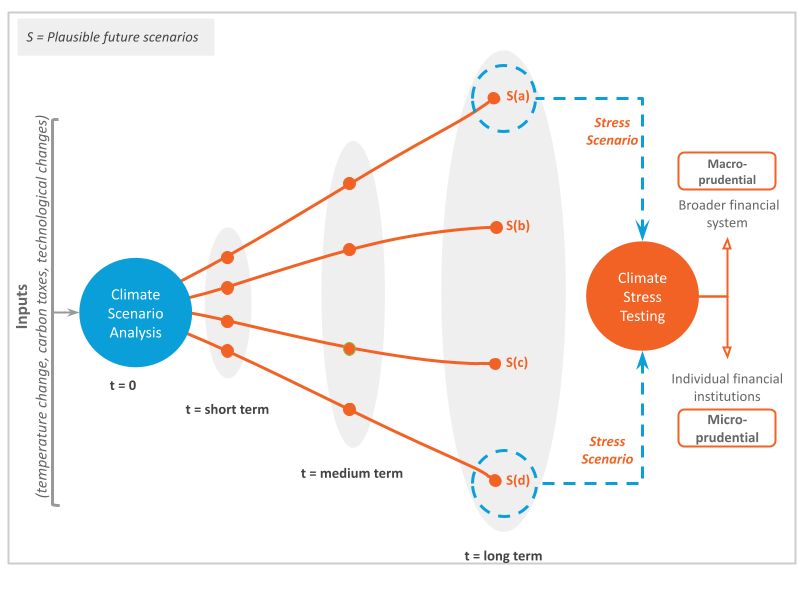
1.It is the assessment of potential climate risk, it typically considers temperature increases, changes in policy (carbon taxes), technological developments, and societal shifts towards sustainability.
2. It follows a flexible ‘what-if’ framework, allowing for an exploration of risks under various possible futures. However, these scenarios are not forecasts, or predictions, but rather hypothetical constructs.
3. Given the long-term nature of climate change, climate scenario models could typically extend 10, 20, or even 30 years into the future.
4. These models serve as a critical tool to enhance strategic decision-making, enabling financial regulators and banks understand to assess systemic vulnerabilities and integrate climate risks into decision-making.
Several important climate scenarios have been developed that aid this process. Notable examples include the widely used scenarios devised by the Network for Greening the Financial System (NGFS), the Representative Concentration Pathways (RCPs) by the Intergovernmental Panel on Climate Change (IPCC), the energy system scenarios developed by the International Energy Agency (IEA), and the Indian Energy Security Scenarios (IESS) of the NITI Aayog.
Stress testing: Assessing resilience under extreme conditions
Stress testing is a risk management tool used by financial institutions and regulators to evaluate how firms and financial systems would withstand extreme yet plausible adverse conditions. These tests measure how a firm or a financial system would respond to economic shocks, such as market crashes, geopolitical tensions, or natural disasters.8
Key features of climate stress testing:
1.Climate stress testing builds upon climate scenario analysis by applying extreme, disruptive climate-related conditions to assess financial stability. While scenario analysis explores a range of plausible futures, stress testing examines the worst-case outcomes to evaluate financial resilience.
2. According to the BIS, climate stress tests are typically conducted at two levels7-
- Macroprudential stress testing — Assesses the broader financial system’s stability under climate-induced shocks
- Microprudential stress testing — Focuses on the solvency of individual financial institutions based on their exposure.
3. It evaluates both physical and transition risks. It helps financial institutions quantify capital erosion due to stranded assets, credit defaults, or revaluations in high-carbon sectors.8,10
4. Unlike traditional stress tests, climate stress tests face challenges due to the long-term horizons, data gaps, and uncertainty in climate risk projections. In cases where quantitative loss estimation is infeasible, stress testing is used to map financial institutions’ exposures to climate-vulnerable sectors.9
Over 60 climate stress testing exercises have been conducted or are underway globally 10, including by the European Central Bank (ECB) and the Bank of England (BOE). The ECB’s approach combines macroprudential 11 and microprudential12 stress testing, whereas the BOE stress tests have been primarily microprudential, with some systemic considerations.13
Figure 1: Climate risk assessment: Scenario analysis to stress testing
Source: Author's analysis
References
- [1] Bank for International Settlements (BIS). 2022. Climate-Related Financial Risks: A Survey on Current Initiatives. Basel: BIS. https://www.bis.org/publ/othp31.pdf.
- [2] EY Global. 2021. Resilient banking: Capturing opportunities and managing risks over the long term. https://www.ey.com/en_gl/banking-capital-markets-risk-regulatory-transformation/how-resiliency-in-risk-management-is-the-new-top-priority-for-banks
- [3] Reserve Bank of India (RBI). 2022. Climate Risk and Sustainable Finance. Mumbai: RBI. https://rbidocs.rbi.org.in/rdocs/Publications/PDFs/CLIMATERISK46CEE62999A4424BB731066765009961.PDF.
- [4] Reserve Bank of India (RBI). 2022. Survey on Climate Risk and Sustainable Finance. Mumbai: RBI. https://rbidocs.rbi.org.in/rdocs/PublicationReport/Pdfs/SURVEYCLIMATERISK3DB3ABB0E087445797BF79BC940AEFC6.PDF.
- [5] Reserve Bank of India (RBI). 2023. Report on Currency and Finance. Mumbai: RBI. https://rbi.org.in/Scripts/AnnualPublications.aspx?head=Report+on+Currency+and+Finance
- [6] Reserve Bank of India (RBI). 2024. Draft Disclosure Framework on Climate-Related Financial Risks. Mumbai: RBI. https://rbidocs.rbi.org.in/rdocs/Content/PDFs/DRAFTDISCLOSURECLIMATERELATEDFINANCIALRISKS20249FBE3A566E7F487EBF9974642E6CCDB1.PDF.
- [7] Basel Committee on Banking Supervision (BCBS). 2023. Climate-Related Financial Risks – Methodologies for Stress Testing and Scenarios. Basel: BIS. https://www.bis.org/bcbs/publ/d518.pdf.
- [8] Financial Stability Institute (FSI). 2022. Stress Testing for Climate-Related Risks: Key Principles and Methodologies. Basel: BIS. https://www.bis.org/fsi/fsisummaries/stress_testing.pdf.
- [9] Financial Stability Institute (FSI). 2023. Supervisory Practices for Climate-Related Financial Risks: Insights from Global Regulators. Basel: BIS. https://www.bis.org/fsi/publ/insights34.pdf.
- [10] Deutsche Bank Research. 2023. Climate Stress Tests: Are Banks Fit for the Green Transition? Frankfurt: Deutsche Bank. https://www.dbresearch.com/PROD/RPS_EN-PROD/PROD0000000000526206/Climate_stress_tests%3A_Are_banks_fit_for_the_green_.PDF.
- [11] Alogoskoufis, et al. 2021. ECB economy-wide climate stress Test: Methodology and results. European Central Bank. Occasional Paper Series No 281.
- [12] https://www.bankingsupervision.europa.eu/ecb/pub/pdf/ssm.climate_stress_test_report.20220708~2e3cc0999f.en.pdf
- [13] Bank of England. 2022. Results of the 2021 Climate Biennial Exploratory Scenario (CBES), available at: https://www.bankofengland.co.uk/stress-testing/2022/results-of-the-2021-climate-biennialexploratory-scenario
